Who owns London? The offshore map — every overseas company on the register, by borough
Thousands of London titles are held in open breach of the law — topped by a convicted scam. Nearly 5,000 belong to dissolved ghost companies, British Rail among them. And London's biggest foreign landlords, counted by the humans behind the companies, are the Irish.
28 September 2026
Four thousand London land titles are held by overseas companies in open breach of a law three years in force. The biggest offender is a convicted scam, with 649 of them. The strangest is Fenland Limited of the Isle of Man, which bought 313 Kensington and Earls Court flats in the summer of 2007 and has never told the register who owns it. Around 800 more sold everything as the law came in and named their owners on the way out, in statements Companies House holds and does not publish. Nearly 5,000 London titles still belong to dissolved companies, one of them British Rail. On Kensington Palace Gardens the owners include The King, the Foreign Office, and 'The Roumanian Peoples Republic', a state abolished in 1965. The priced fraction of offshore London comes to £69.3 billion. And counted by the human beings actually behind the companies, the biggest foreign landlords of London are the Irish.
Here is the whole piece in one box. Chiswick High Road: 585 company- and overseas-owned titles, all fourteen ownership situations we classify, on one ordinary high street. Now type your own street.
Live tool — type any London street
None of that needed a leak or a lawsuit. It's all in public registers, and we're not the first to look: Private Eye mapped offshore England in 2015, the BBC and Transparency International counted the lawbreakers in 2023, and Tax Policy Associates mapped the hidden owners nationally this January. What hasn't been done is the other half: joining the domestic register too, x-rayed through the same beneficial-ownership records and read at street level. All 704,031 company-owned London titles, one lens. Findings first; machinery at the bottom.
The ones that never registered
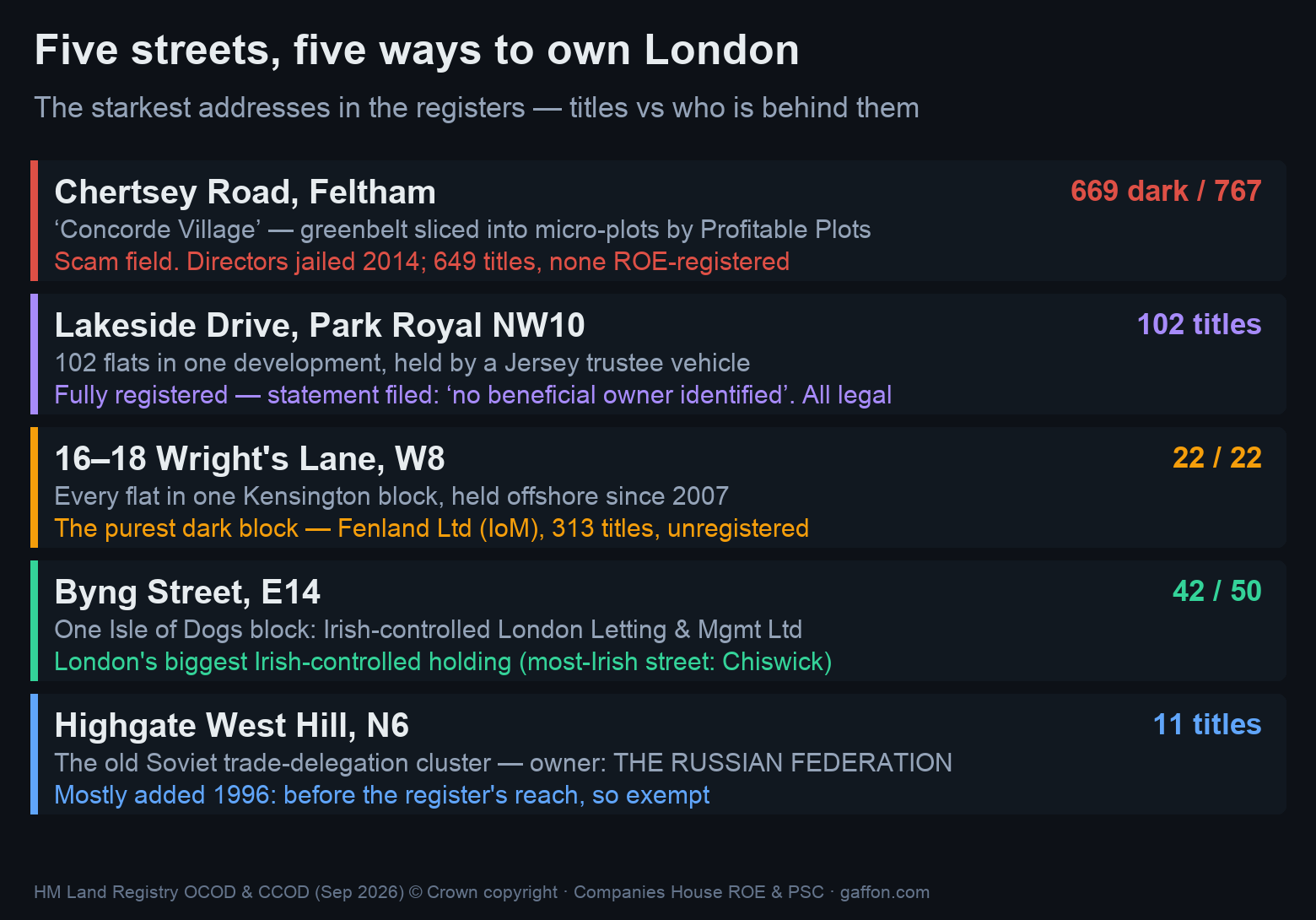
Since January 2023 an overseas company that owns UK property must name its beneficial owners on a public register. An unregistered owner can't legally sell, lease or mortgage, and risks criminal penalty. 2,199 overseas owners, holding 4,000 London titles, have never registered. The biggest is Profitable Plots Pte Ltd of Singapore, on 649 titles: a land-banking scheme whose directors were jailed for seven and eight years in 2014 for cheating investors. Its titles are greenbelt micro-plots near Heathrow, sold one by one to small investors on the promise of planning permission that Hounslow council had said would never come. The road they sit on, Chertsey Road in Feltham, is the darkest street in London. 669 of its 767 registered titles trace to nobody, and the 22 dark titles that aren't the scammer's belong to its victims, still holding slivers of a field seventeen years on.
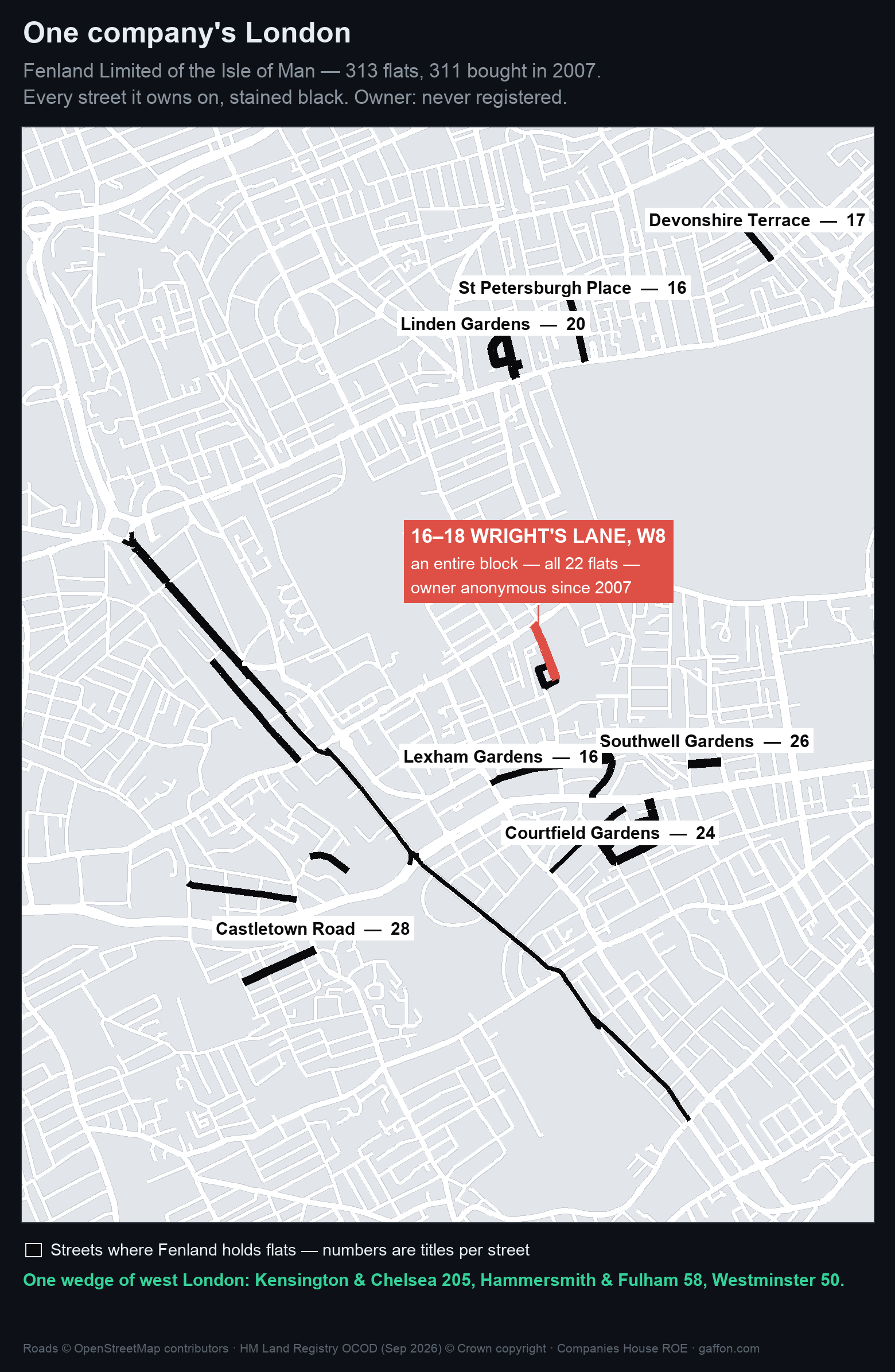
Fenland is the biggest absence with a postcode, and the map shows its style: whole blocks at a time, all inside one wedge of west London. As far as we can find, its name has never appeared in print.
Every big name checked out. Deutsche Bank, the Qatari royal family's vehicles, the listed hotel groups: all registered. Compliance at the top is near-total for a boring reason: a lawyer costs less than a frozen title. What's left is wreckage, and a few puzzles. MedicX Properties V Limited of Guernsey holds 19 GP surgeries and never registered, while its 37 sister companies all did.
The unregistered league by flag: British Virgin Islands (738 titles), Singapore (715), the Isle of Man (405), Luxembourg (300), Jersey (275), Guernsey (121), Panama (105). Caveats: Singapore is mostly the scammer's 649 and the Isle of Man mostly Fenland's 313, so the league measures wreckage more than strategy, and the totals are upper bounds (method at the bottom).
The dash you can't see
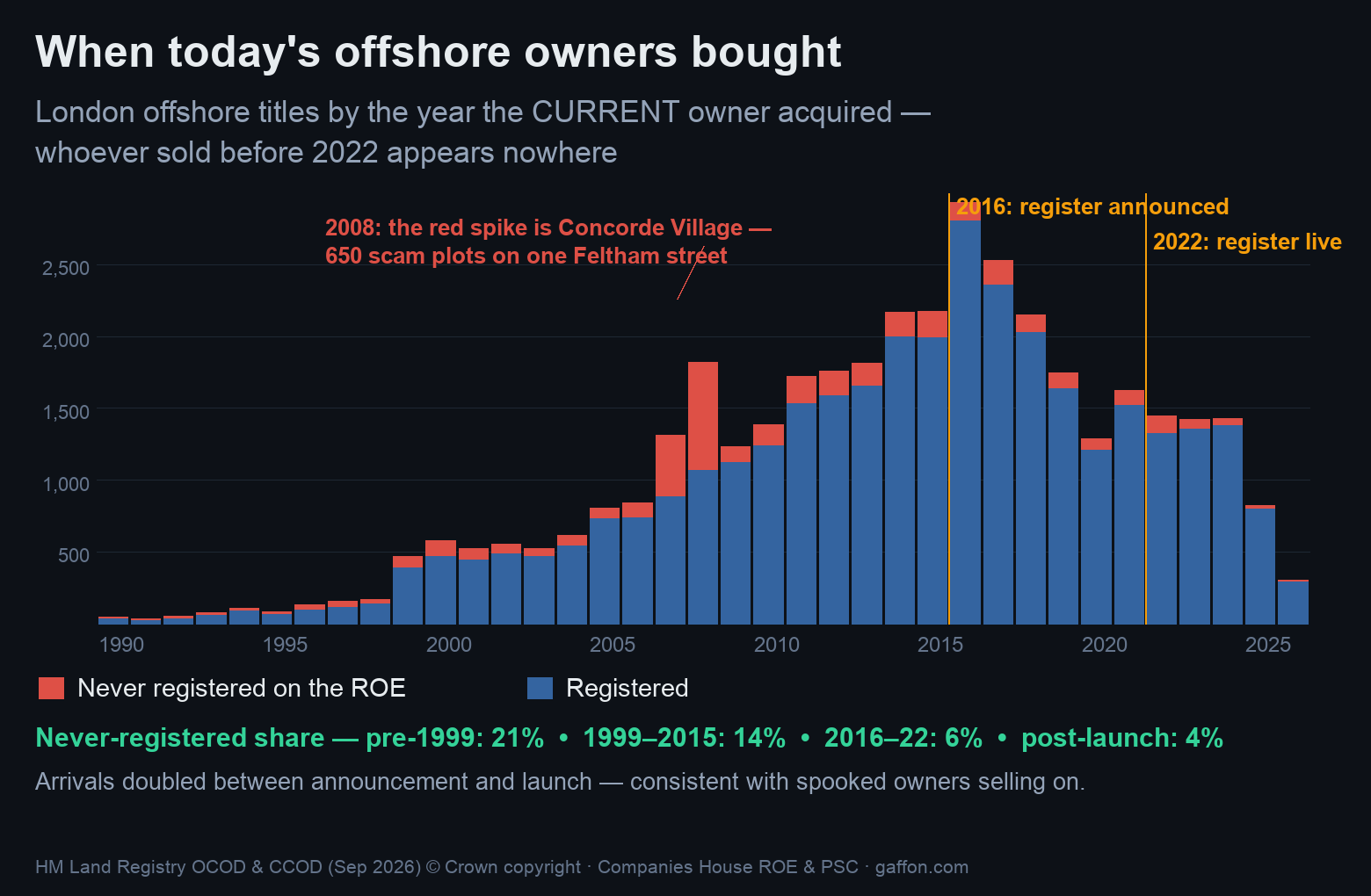
The register was promised at the 2016 anti-corruption summit, drafted in 2018, and passed in March 2022 after the invasion of Ukraine. Six years of warning. So did dirty money get out while the door was closing? The data can only half-answer: the land register is a photograph of whoever was still in the room when the music stopped, and anyone who sold before 2022 appears nowhere. What it does show is arrivals running at nearly double the usual rate between announcement and launch. Before calling that panic, we ran the one control available.
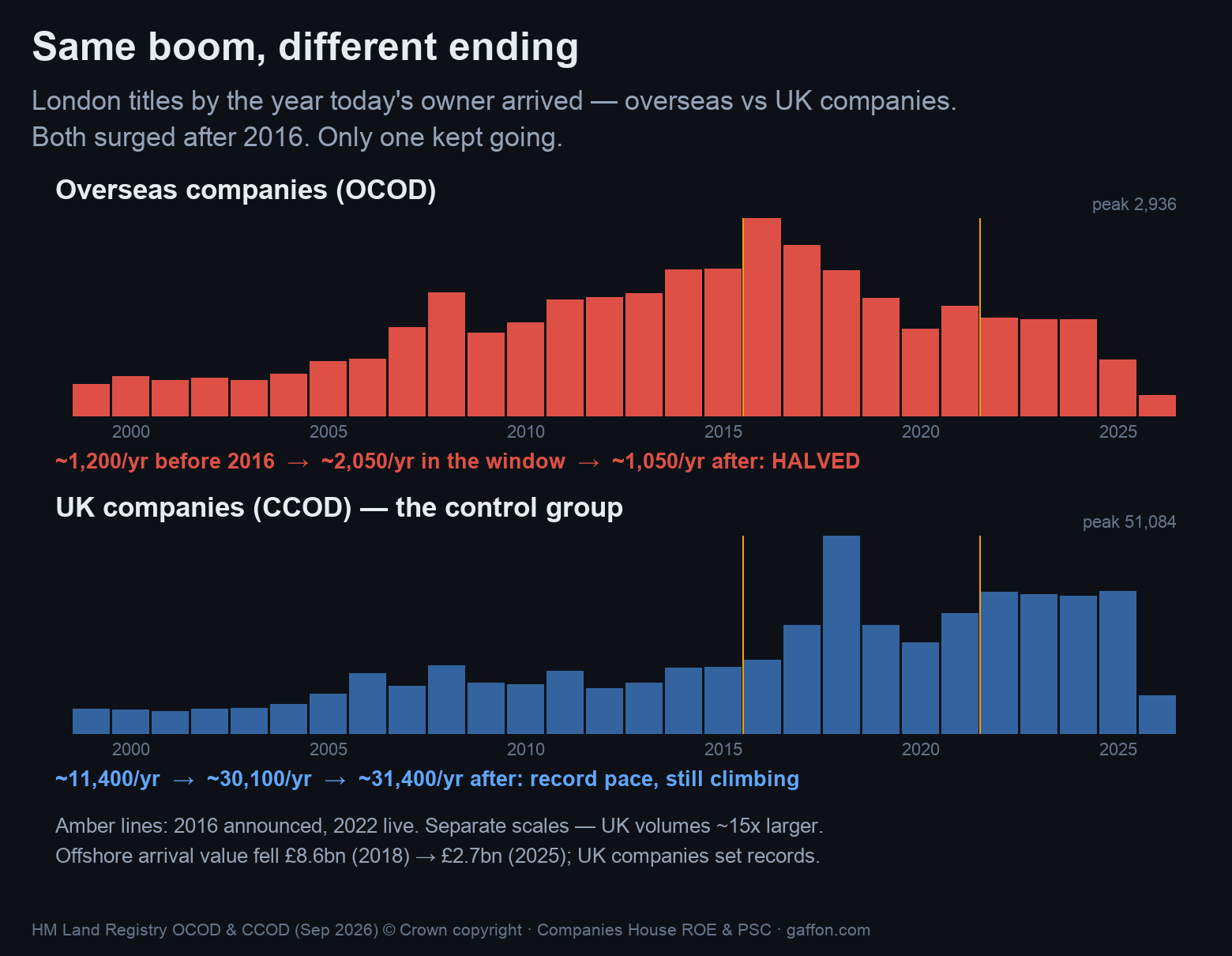
UK companies had nothing to fear from an overseas-entities register, which makes them the control group, and the chart says it plainly: both surged after 2016 (the 2017 landlord tax change pushed buy-to-lets into companies), so the rise was the market. The register shows in the ending, where offshore arrivals halve and UK arrivals keep setting records. Transaction studies (Advani and colleagues; Collin, Hollenbach and Szakonyi) agree: haven purchases fell roughly 30% in number and 80% in value after the draft bill. Parliament also wired a tripwire for leavers: sell after 28 February 2022, the day the bill entered Parliament, and you had to declare your owners anyway. About 800 overseas entities sold everything and filed exactly that statement. Companies House holds them and does not publish them. Nobody has prised them open; the 2023 reforms' 'legitimate interest' route to withheld register material sits untried.
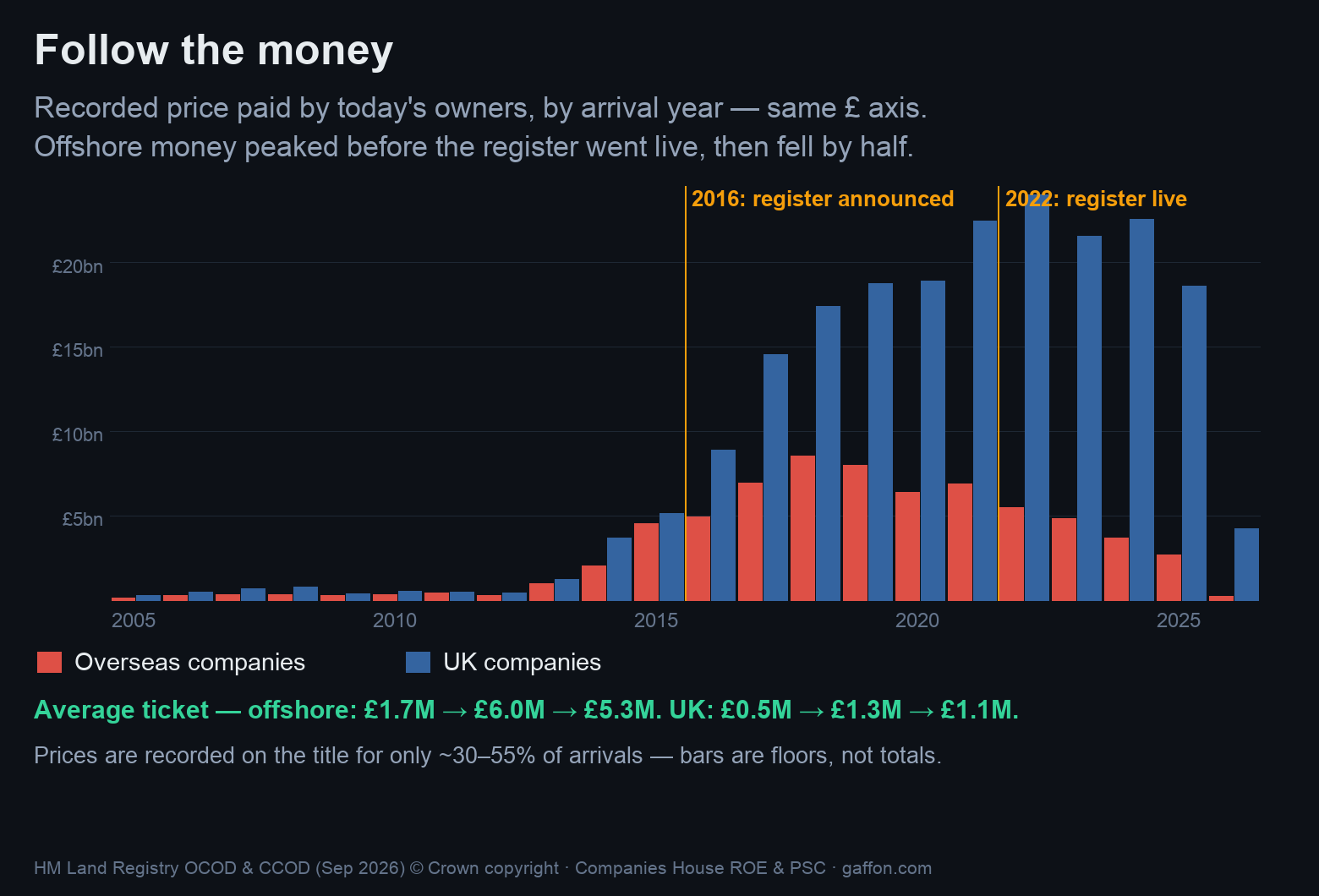
The money chart adds a twist: the average offshore purchase tripled in the window while UK-company tickets merely rose with the market. Fewer, bigger cheques. And title by title, 3,596 London titles changed hands offshore-to-offshore in the window, ten times the 2016 baseline — but up close almost all of it is housekeeping: hotel groups rearranging, trustees renaming, ground-rent funds consolidating. The discreet exit was to sell the company rather than the property: the title never moves, and the seller's name is gone.
You can still hide
To be fair to the machine: mostly, it works. The BVI company that paid £262.9M for a parcel at Canary Wharf resolves, two clicks later, to two named individuals with their nationalities stated. Land register to company name to Companies House to named people, free and public. We ran the whole London register through that chain: 90% of London's overseas-owned titles trace to a registration, and of those, 59% declare a named human being.
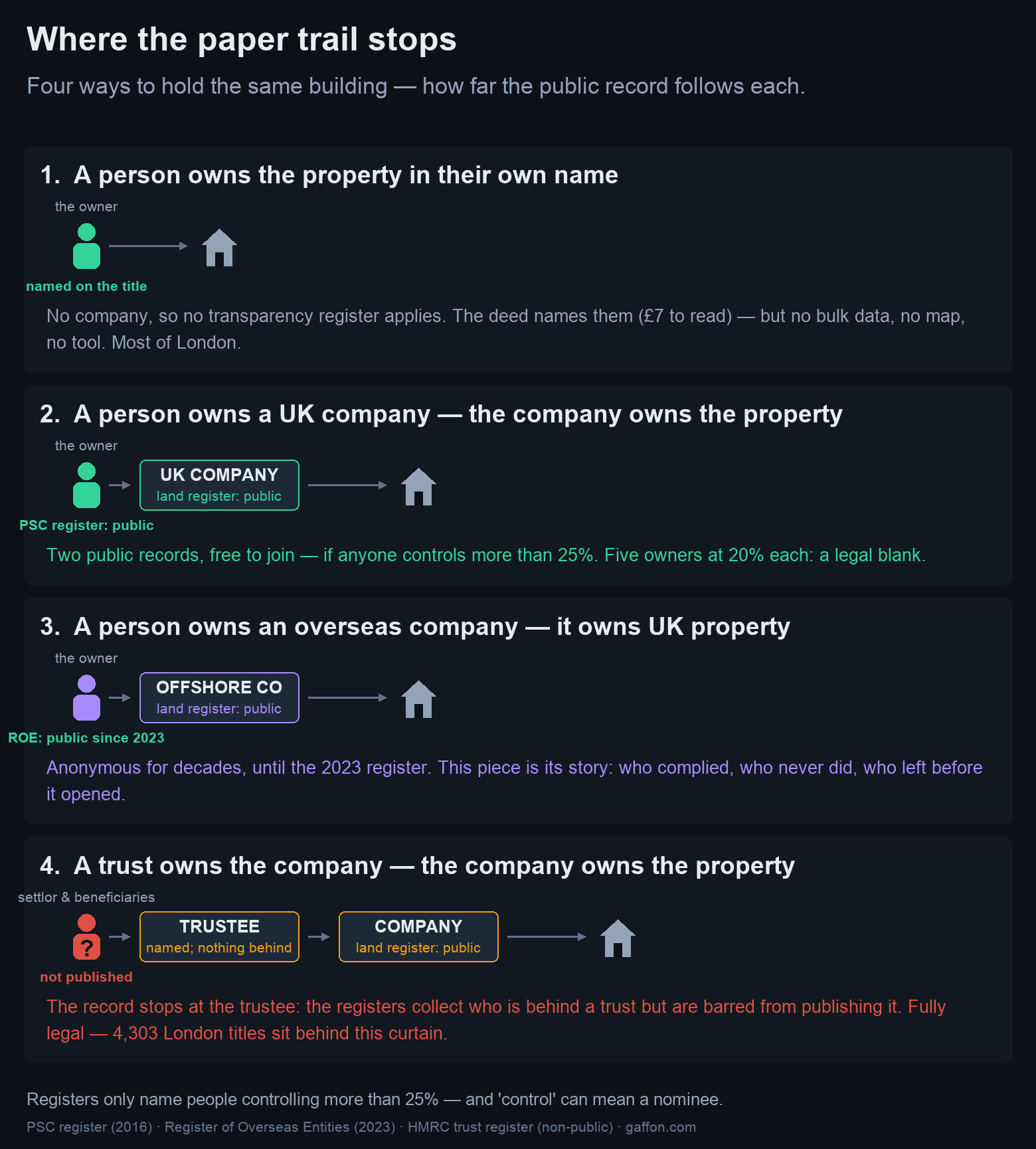
But the register has a compliant way to stay anonymous, and the trustees found it. 4,303 London titles belong to entities that registered and still name nobody: the filing literally says 'no beneficial owner identified'. The names tell you why. Regency Heights Trustee 1 Limited (Jersey, 102 titles), Zedra Trust Company Limited (Jersey, 48). Where a trust sits in the chain, the register shows the structure but not the settlor.
There is also one fully legal blackout: the register only reaches land acquired since January 1999. 1,090 London titles are older than that, formally exempt, no beneficial owner ever required. The most evocative exempt holder is The Russian Federation itself, on a dozen titles around Highgate West Hill: the old Soviet trade-delegation compound, including a mansion called The Eagles, almost all added in one batch in May 1996. With one exception: a flat at 37 Harrington Gardens, Kensington, added to the Russian state's portfolio in 2017, inside the register's reach and not on it.
So the honest summary of Britain's transparency machine is that it names most of the money and leaves three doors open. Buy in your own name: people aren't on these registers at all, only companies. Hold since before 1999: exempt. Or file as a trustee: registered, compliant, anonymous. These registers capture the structured money, which is exactly the money people mean when they ask who really owns London.
Owned by ghosts
Open defiance of the domestic companies register barely exists: 40 London titles. The stranger number is that 4,779 titles are still registered to companies that have been dissolved. Companies House says the owner stopped existing; the Land Registry hasn't heard. BRB (Residuary) Limited, British Rail's leftovers company, wound up in 2013, still owns nine pieces of London; the collapsed Threshers off-licence empire, dissolved in 2015, owns another nine. Ownerless property eventually drifts to the Crown as bona vacantia; nobody is hurrying to tell it. There is no ghost street, though: dissolution doesn't cluster; ghosts haunt individual buildings.
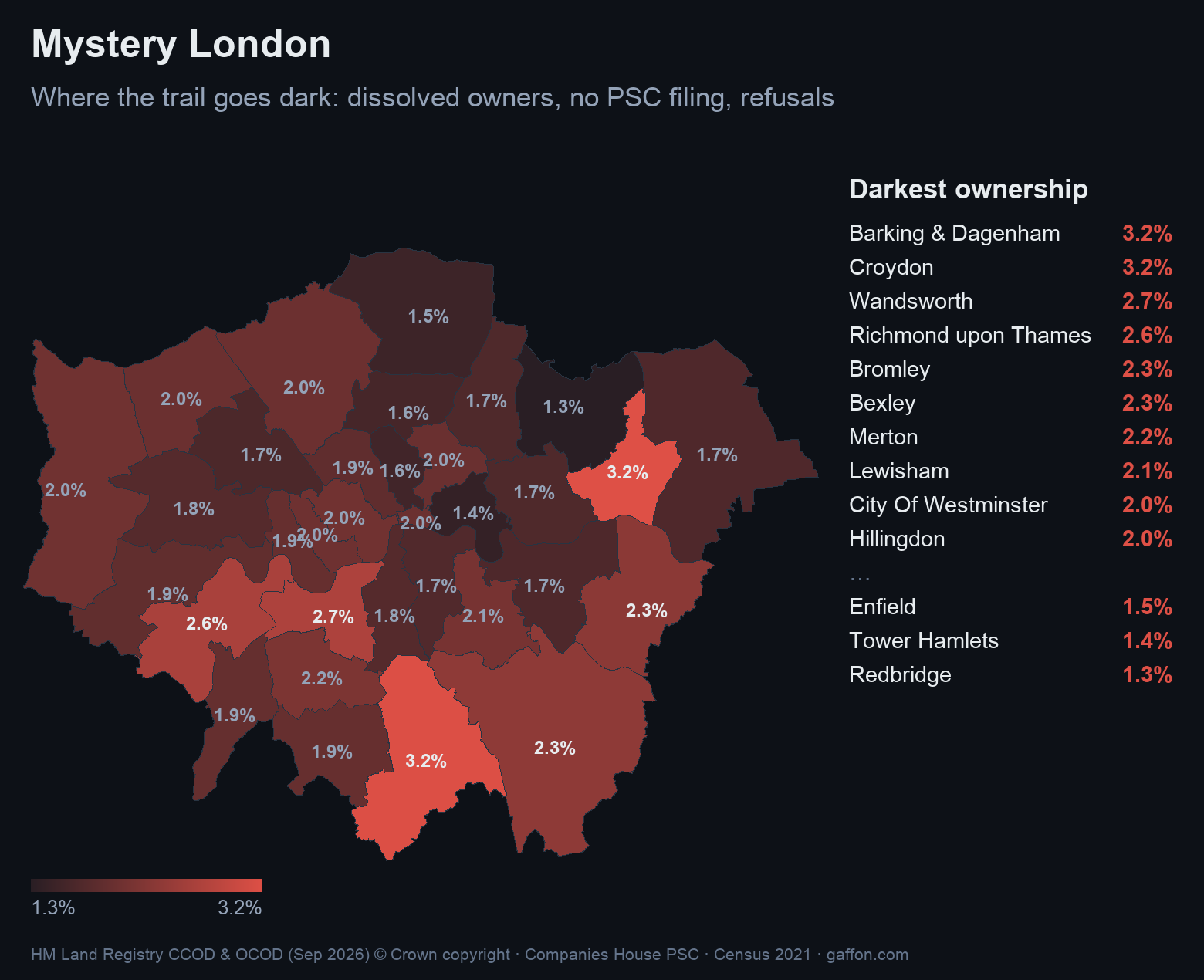
The dark trail peaks not in Mayfair but in Croydon and Barking & Dagenham.
Who owns company London
Company London is 704,031 land titles: 664,904 through UK companies, 39,127 through overseas ones. Ask who is actually behind each owner and the private-equity stereotype goes first: the biggest owner of company-held London is named individuals, ahead of corporate chains. Less Blackstone, more bloke with three flats. The giants are unglamorous (housing associations, London Power Networks, TfL, the councils), and the owners are young: companies incorporated since 2010 hold over 200,000 titles.
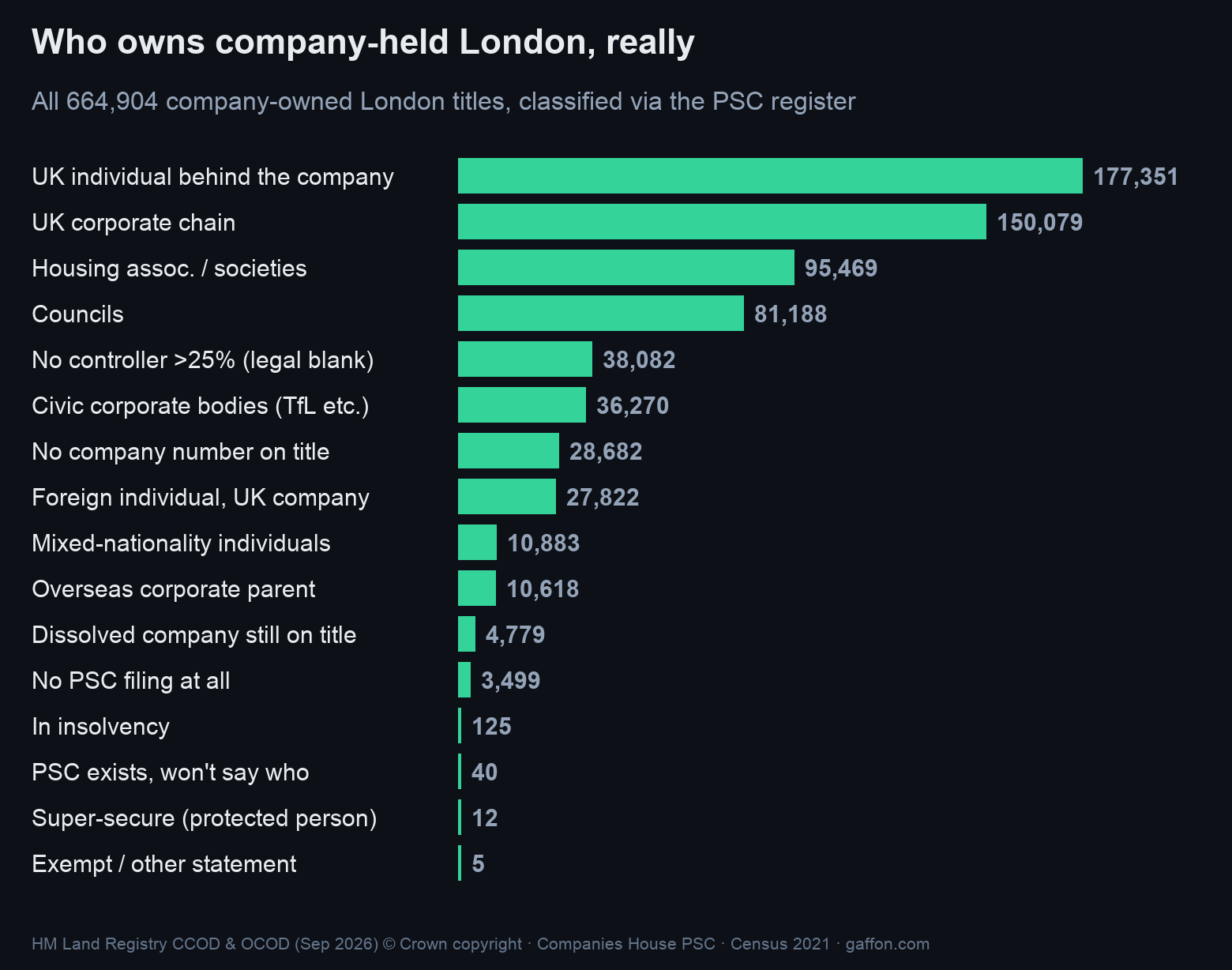
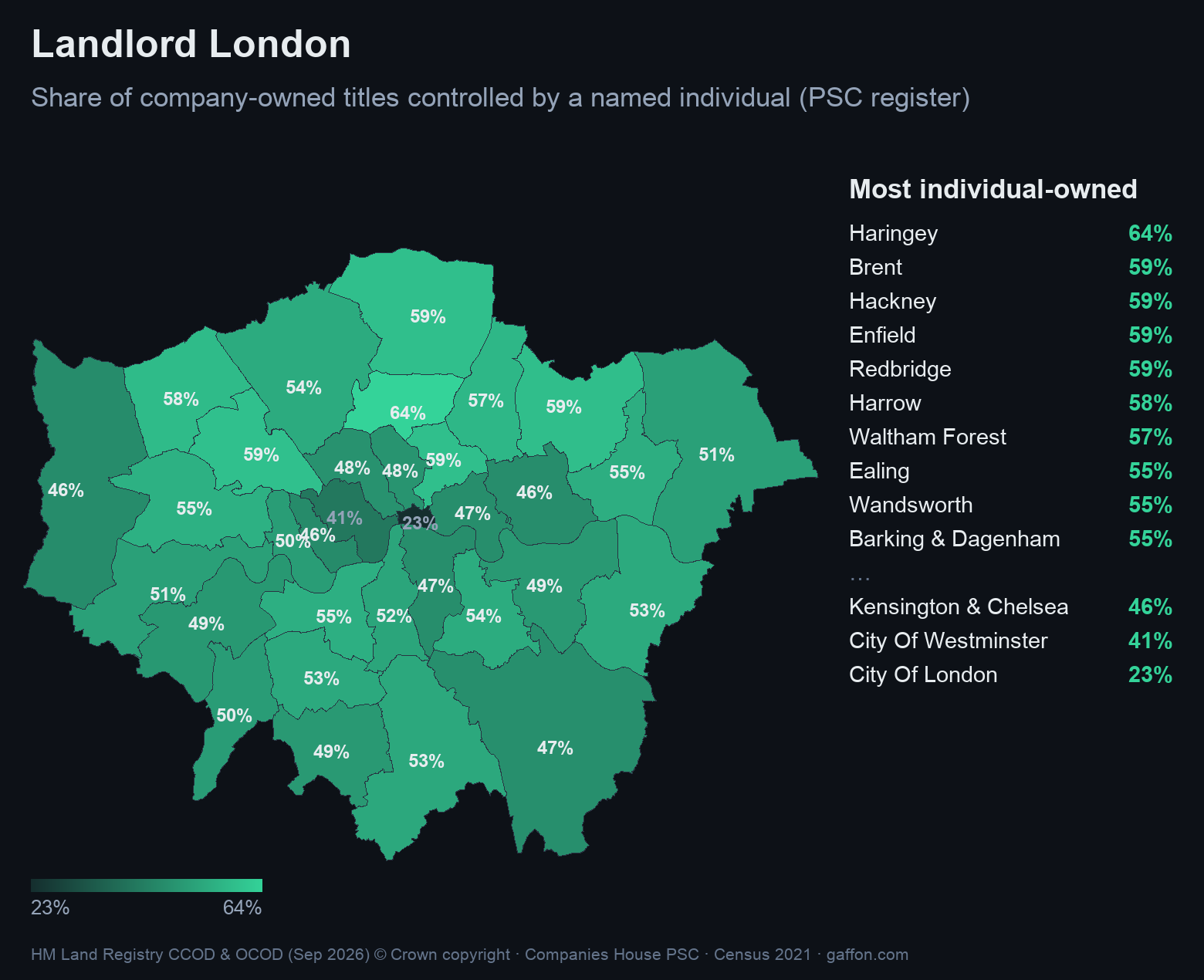
The individual-landlord belt is the outer ring: Haringey, Brent, Enfield, Hackney. In Westminster and the City, the individuals give way to chains.
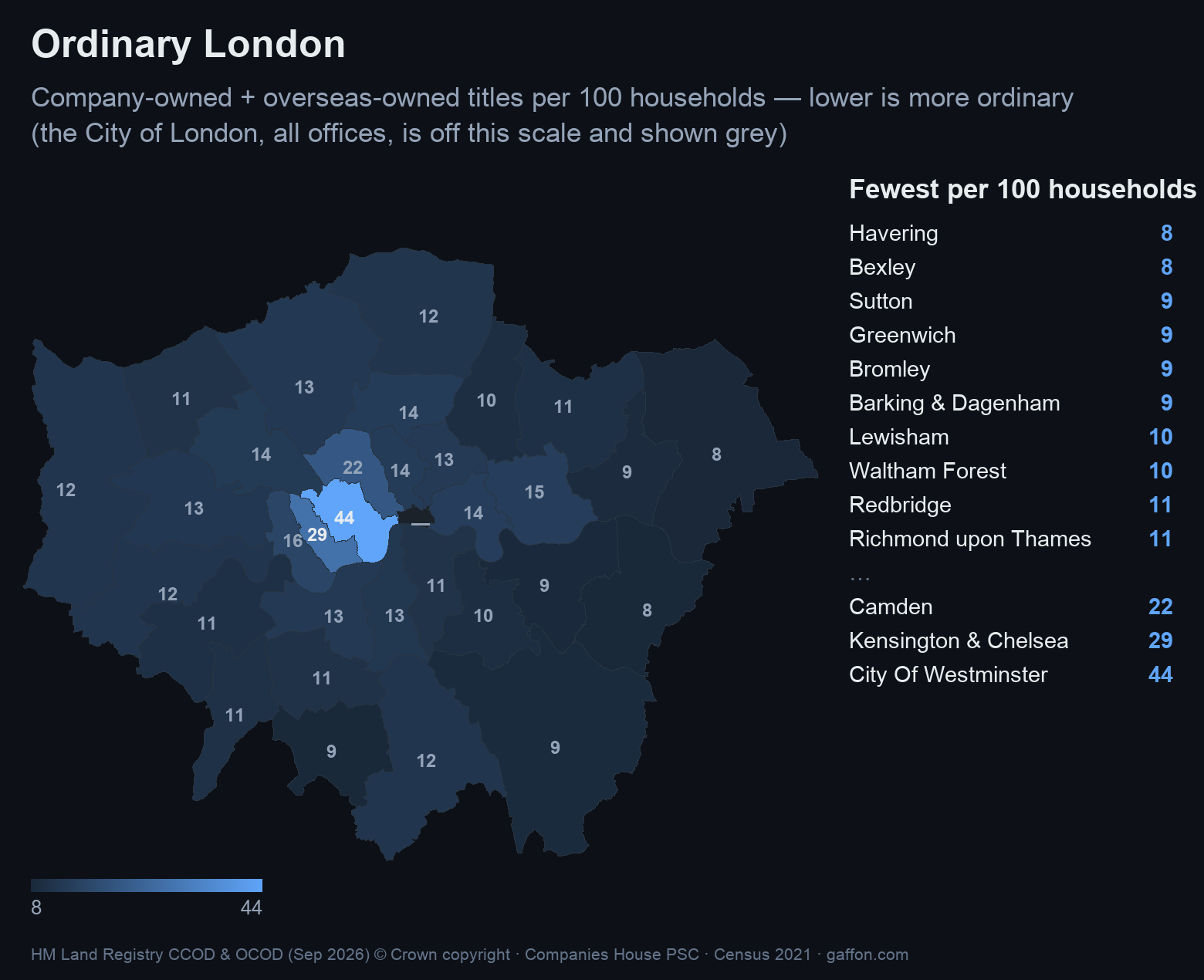
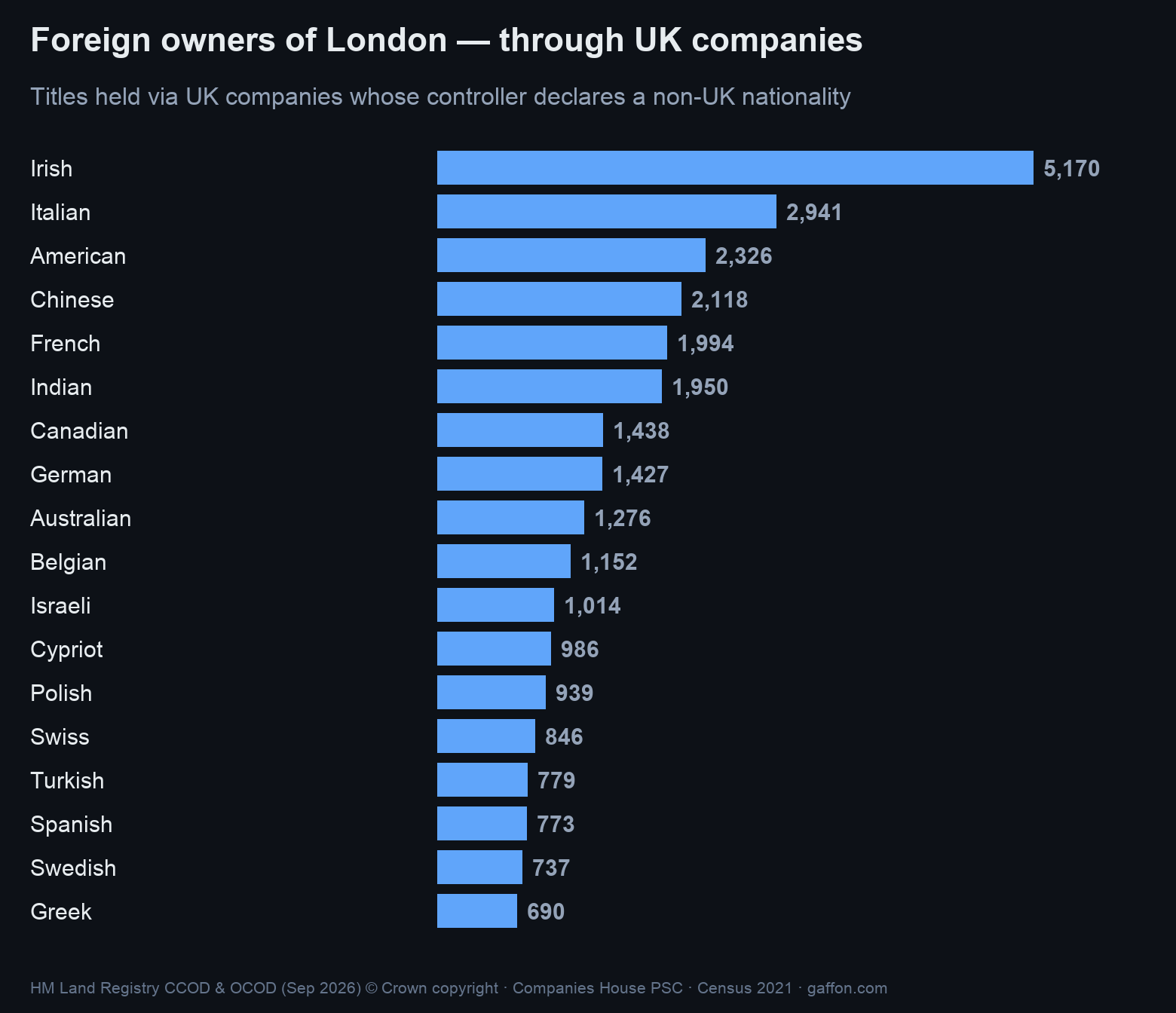
Strip out the British and the Irish come first. The biggest single Irish holding is one Isle of Dogs block on Byng Street, where London Letting & Management Limited owns 38 flats. The most Irish street, counted by separate Irish hands, is of course Chiswick High Road: five Irish-controlled companies along one parade. (Hamptons counts newly formed landlord companies with Irish founders third, behind Indian and Nigerian nationals: that's the flow; the stock is still Irish.)
The flag on a company is not the passport of its owner. Nobody 'French' holds London through a French company: a wrapper gets built where it is cheap, private and tax-neutral, usually with an eye on taxes back home, not Britain's. That is why the overseas register reads BVI, Jersey, Guernsey, Isle of Man, Singapore, and why actual Ireland, all insurers and trustees and one Dublin developer, accounts for just 512 titles. The wrappers have habits: 65% of every BVI title in England and Wales is in London (Jersey money buys the whole country; BVI money buys London), 63% of London's offshore titles are flats, and Westminster plus Kensington & Chelsea hold 37% of the city's pile.
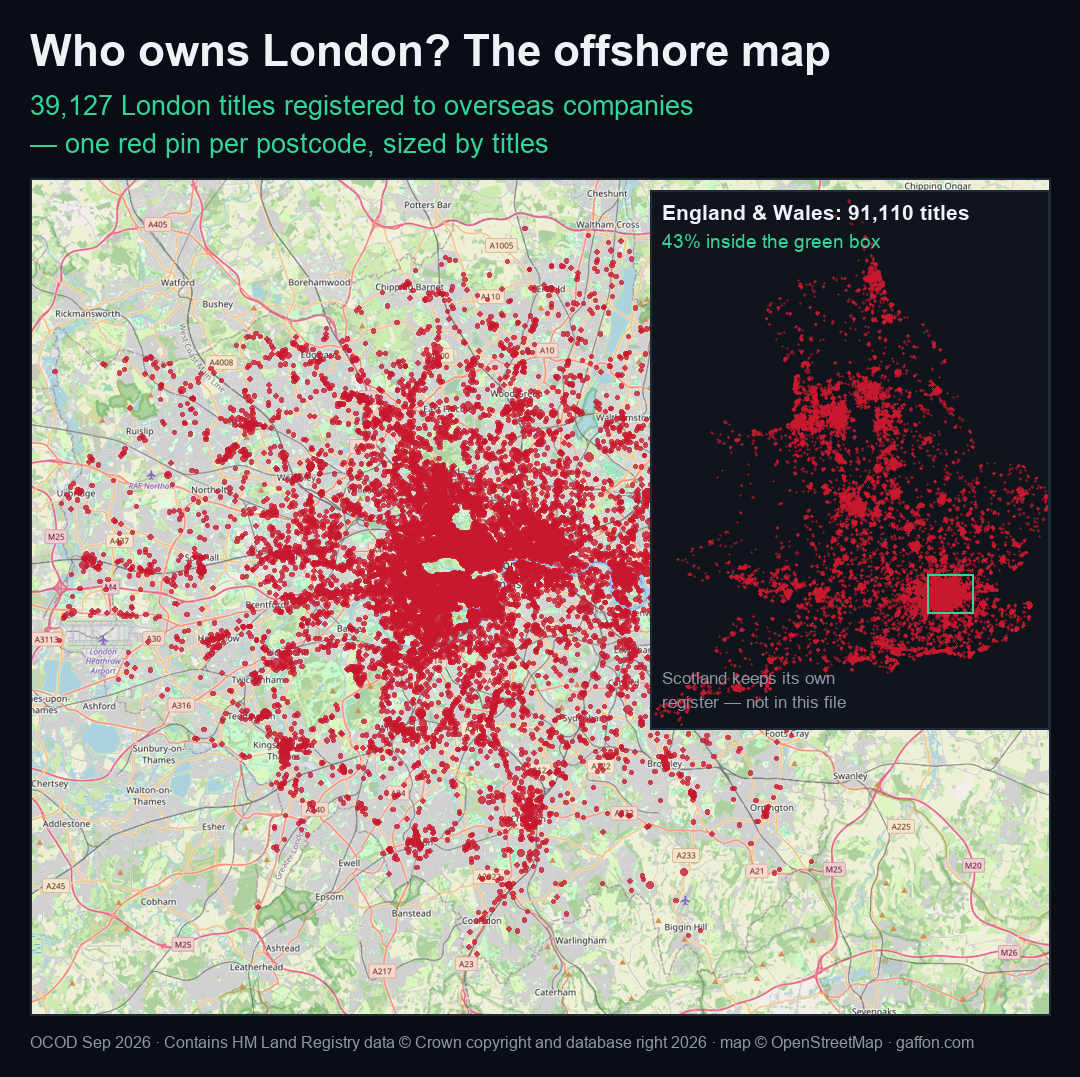
Only 16,178 of London's offshore titles carry a recorded price, and that minority alone adds up to £69.3 billion. The biggest are all Jersey companies: the £793M Arundel Great Court on Temple Place, the £448M Blue Fin Building, and New Scotland Yard, at £370M.
One street, every situation
The lookup at the top of this page works for any London street. On Cadogan Square in Knightsbridge, overseas companies hold 112 titles and UK companies another 113, led by the Cadogan family's estate company: old money and offshore money sharing a garden.
Who owns my street? →Where the numbers come from
Most countries treat property ownership as a secret. Britain half-agrees: if a company buys property, the fact goes on a public register, free to download, updated monthly. Four files make this piece: HM Land Registry's overseas-company titles and UK-company titles, and Companies House's Register of Overseas Entities and persons-with-significant-control file. The two registers of what's owned, joined to the two registers of who owns, by company number and name.
The honest caveats. The land registers show current owners only, so past owners who sold don't appear, and some rows are stale the other way, still naming owners who have sold. Our overseas matching is by normalised company name, so a rename can look like non-registration; every company named in this piece was therefore checked by hand against the live register, previous names included. The company-number field contains Land Registry typos, which we repaired by name before declaring anything dead.
One thing we'd love to show and can't: address-by-address ownership. The proprietor names and street totals are Crown data we can publish freely; the individual property addresses carry third-party Royal Mail rights we can't republish. For any specific property, the Land Registry sells the title for £7.
Ireland, by comparison, publishes far less about its buyers — but what it does publish still answers more than most people think.
Curious what actually sold on your street? Every sale is on the map.
Citing this analysis: “gaffon.com analysis of HM Land Registry OCOD/CCOD and Companies House ROE/PSC registers, September 2026.” Journalists: the full dataset and any custom cut are available on request, same day.
Sources: HM Land Registry, Overseas Companies that Own Property in England and Wales (OCOD) and UK Companies that Own Property in England and Wales (CCOD), full files September 2026 — contains HM Land Registry data © Crown copyright and database right 2026. Beneficial-owner records: Companies House — Register of Overseas Entities, persons-with-significant-control snapshot (29 September 2026) and basic company data (September 2026). Households: Census 2021, table TS041. Prior work credited in text: Private Eye (2015), BBC/Transparency International (2023), Tax Policy Associates (2026), Advani et al. (Warwick/LSE), Collin, Hollenbach & Szakonyi. Map © OpenStreetMap contributors; geocoding via postcodes.io.
Ready to list your home?
Free for everyone — no fees, no commission. The wizard walks you through it, step by step.
List my home — free →Looking to buy?
Every home on one map, with video tours.
View homes for sale →More from the Gaffon blog
- Oxford v Cambridge →
- Off-market listings: the advantages →
- How to film a video tour that sells your house →
- Can I sell my house without an estate agent? →
- What did my neighbour's house sell for? →
- Do I need an EPC to sell my house? →
- Sea view homes for sale UK: £599k to £950k →
- UK coastal homes under £500k →